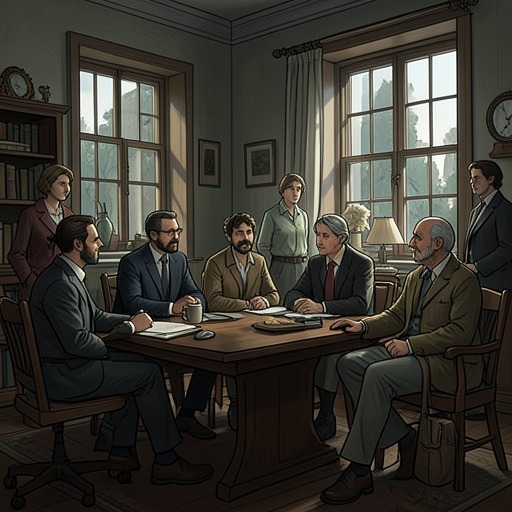
Dreams and Reality
Night and DayDreams and Reality is a central tension in the novel: inward vision offers characters forms of beauty and possibility that their material and social circumstances deny, yet it can also distort their understanding of other people and leave them exposed to disillusionment. Ralph Denham tries to keep imagination separate from work; Katharine Hilbery enters an inner world where feeling can move without restraint; and their experiences show that reality may break an idealized attachment without destroying the imaginative energy that gave it life.
Ralph’s divided life
Ralph’s outward future is modestly respectable. He imagines himself with a strong brain, a seat in the House of Commons at fifty, a moderate fortune, and perhaps an unimportant post in a Liberal Government. But this forecast is less secure than it appears. Keeping to the path toward it takes force of will and pressure from circumstance, as well as repeated assurances to himself that he shares the common fate, prefers it, and wants no other. Those self-reassurances help him acquire punctuality and habits of work, and let him present his clerkship in a solicitor’s office as the best possible life. His practical discipline is therefore not proof that he has no other ambitions; it is something he must continually maintain.
Away from public opinion, Ralph swings into private imaginings of noble and romantic parts. These dreams are not merely self-glorification: they release a spirit with no outlet in his working life, a power he associates with making waste places flower, curing ills, and creating beauty. The same force threatens the ordered world he has built around his profession. He imagines it devouring the dusty books and parchments on the office wall and leaving him exposed. At twenty-nine, he believes he has managed to divide his life rigidly into hours of work and hours of dreams, with each existing beside the other without harm. Yet his old conclusion—that life compels people to exercise their lesser gifts and wastes their precious ones—gives that division its melancholy edge. Work sustains him, but does not persuade him that his imagination is unneeded.
Katharine’s inner world
Katharine’s imagination moves differently. After Ralph quietly tells her that thinking of her does him good, without declaring love, she feels an affection for him stronger than she has yet known. But she is also convinced she will marry William Rodney, as though the decision were difficult to avoid or question. When she sets marriage aside in thought, she enters a dream state in which she becomes another person and the world seems changed. To her, this inner realm contains the realities behind the appearances of ordinary life: feeling is more direct and powerful there, and beauty and happiness appear whole rather than in the fragments available in waking life. Its furnishings draw, in part, on the past, including Elizabethan England.
The dream world gives feeling freedom from the restraints of actual life, but it does not offer a permanent escape. Katharine does not meet familiar people transformed or play a heroic role; instead, she loves a magnanimous hero and moves with him among the trees of an unknown world, sharing feelings that arrive with the force of waves. The dream’s release is accompanied by resignation and a stoical acceptance of facts. As she hears Rodney moving things on his dressing-table, the ordinary room returns. She shuts the book she has been holding and puts it back on the shelf. Her inward excursion has not altered her circumstances; it has briefly made perceptible the emotional abundance that those circumstances leave unrealized.
Ideals and the difficulty of truth
The novel also tests what ideals can do in practical life. When Katharine asks Ralph whether he is a poet, she tells him she thinks he speaks the truth. He says he has written no poetry for years, yet insists that poetry is the only thing worth doing because, he supposes, it keeps an ideal alive that might otherwise die. Katharine responds that she does not know whether ideals make much sense. Their exchange sets two positions against each other: Ralph sees imaginative creation as protection for a value that ordinary life might extinguish, while Katharine questions the usefulness of ideals without denying the reality of what she feels.
Their difference also cautions against treating dreams as dependable forecasts. Ralph’s romantic imagination can lend Katharine an almost worshipful remoteness, while her own dream life reveals feelings more vivid than the choices she makes in waking circumstances. In both cases, the intensity of an inward experience is real, but it does not establish a reciprocal bond or settle the practical question of marriage. The novel gives imagination emotional force while keeping distinct the imagined meaning of a relationship and what either person has actually promised.
Disillusionment and what remains
When Ralph learns that Katharine is engaged, the reality of her existing commitment breaks into the future he had privately built around her. He feels that his life has become impoverished and that the familiar path ahead has narrowed to a meagre end. At first he comforts himself with the thought that Katharine has treated him badly and may eventually apologize; reflection strips away that defense. She had promised him nothing and taken nothing from him, and his dreams had meant nothing to her. The pain lies not only in losing a hoped-for future but in recognizing that the inner life he had invested in her was his own, not a shared understanding.
The riverside scene gives this recognition physical and imaginative shape. Seated in the chilly fog, with the far bank obscured and its lights suspended against blankness, Ralph watches his disillusionment spread. The dun-colored river seems to embody futility and oblivion; people and things become insubstantial, and even his former romance looks foolish. Yet the end of the scene is not simply surrender. He recognizes that a person may cast away the human forms to which passion seemed attached and still retain the passion itself. It returns on his horizon like the winter sun making a greenish pane in the west as clouds thin. Katharine no longer embodies his belief, but the energy of feeling survives and will have to guide him through an emptied world.
Imagination in the real world
Later, on a train bound from Disham, Ralph’s attempt to imagine Katharine at her father’s address again shows both the power and the limit of fantasy. The letter he carries establishes only that Mr. Hilbery will be at that address for a fortnight; it does not say Katharine will be there. Ralph nevertheless pictures an old gray manor-house and a light behind straight trees, imagining Katharine within the landscape. He checks the vision when instinct warns that reality is pressing in, particularly the fact of William Rodney. Since hearing of the engagement, he has tried not to furnish his dream of Katharine with the details of actual life.
The green light in the late afternoon briefly becomes a symbol of her, enlarging his heart and making her seem present in the carriage, thoughtful and tender. But the vision comes too close and must be dismissed as the train slows. Its jolting movement brings him awake to Mary Datchet on the platform, a sturdy russet figure marked with scarlet. Ralph chooses to walk with her across the fields rather than ride with Edward, and finds comfort in her presence. The transition from imagined Katharine to the real Mary does not make imagination false; it shows how abruptly it yields to the people and choices actually before him. Across these episodes, dreams remain a source of beauty, idealism, and emotional renewal, but reality determines what can be shared, promised, and lived.